



What matters to you in 30 seconds
-
Stock markets continue to reach new highs, but those gains are increasingly being driven by a relatively small group of technology companies.
-
Investors remain enthusiastic about Artificial Intelligence (AI), but they are becoming more sensitive to signs that expectations may be running ahead of reality.
-
We remain moderately positive on equities, while maintaining diversification through high-quality bonds, gold and downside protection in eligible portfolios.
Chart of the weeK
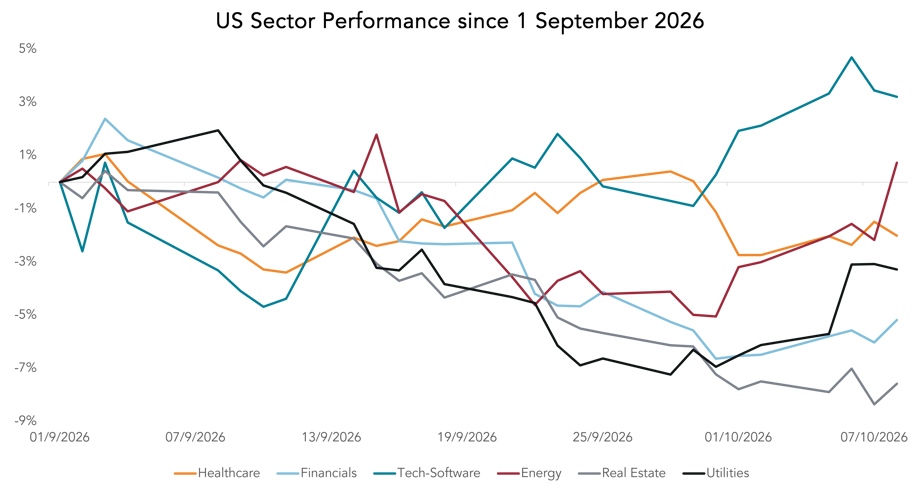
Source: LSEG Datastream. Past performance is not a reliable indicator of future results.
Figures shown are based on selected US sector ETFs.




Record highs don’t always point to a simple story
When markets continue to climb, it is natural to assume the gains are broad-based and supported by a healthy economic backdrop. Last week, however, the most interesting development was not that markets reached new highs. It was that the foundations beneath those highs continue to narrow.
The chart shows that while technology software companies have continued to advance since the start of September, sectors including healthcare, financials, utilities, and real estate have all moved lower.
The same trend can be seen across the wider market. Almost 40% of companies in the S&P 500 had fallen between the market low in late March and the start of last week, despite the index itself reaching fresh records. Smaller companies have also lost much of the momentum they displayed earlier in the year.
While headline market performance remains strong, an increasing share of that performance is coming from a small group of companies.
The AI debate is changing
It wasn’t long ago that many investors were still debating whether AI would genuinely become a transformative force for businesses and economies. Today, most have accepted that it will.
The bigger question now is whether AI companies can keep delivering the sort of growth that investors have come to expect. Many of the strongest-performing companies in the market are also the biggest beneficiaries of AI spending. Their earnings have been strong enough to support valuations that would have once seemed ambitious.
But that success is creating a potential problem. The more the market depends on a narrow group of companies, the less room those companies have for disappointment.
Last Thursday's technology sell-off is a good example.
Reports suggesting that OpenAI's annualised revenue was around USD50 billion rather than USD70 billion triggered a sell-off in AI-related shares. The Nasdaq fell around 1.3%. The reported difference reflected revenue measurement rather than a collapse in demand, but investors reacted quickly, nonetheless.
The question of whether growth expectations have moved beyond reality is likely to become more important as other AI companies seek public-market funding, including the anticipated flotation of Anthropic next month. Investors will increasingly focus on revenues, funding requirements and eventual returns on the vast sums being invested across the industry.
Why diversification still matters
Neither the record highs nor the tech sector sell-off changes our constructive view on equities.
Economic growth remains resilient and the AI investment cycle continues to support company earnings. We therefore maintain a moderate overweight position in equities, with preferences for US and emerging-market stocks.
However, a more concentrated market strengthens the case for diversification.
Investors often think about diversification when markets are struggling. In reality, it can be just as important when markets are performing well. The risk is not that growth disappears overnight. The risk is that confidence becomes concentrated in a small number of companies, sectors or themes.
That is one reason we continue to complement our equity exposure with an overweight allocation to gold and downside equity protection in eligible portfolios.
We also see increasing value in parts of the bond market. Government bonds remain volatile, with US 10-year Treasury yields reaching around 5.36% last week before retreating, falling roughly 10 basis points during Thursday equity sell-off. However, the bond market’s adjustment is not one-way. Demand for US Treasuries remains, suggesting investors are becoming attracted by the higher income available.
Reflecting both those opportunities and our concerns about European political and fiscal risks, we recently reduced European government bonds from overweight to neutral and increased US Treasuries to a moderate overweight position.
This week
Can earnings justify the market's confidence?
The coming weeks may help determine whether the current rally can broaden or whether it continues to depend on a relatively small number of market leaders.
Third-quarter earnings season begins this week with major banks reporting results. Investors will also be watching US inflation data and economic releases from China for further evidence on growth and pricing pressures.
For now, investors remain comfortable with a market increasingly driven by a small group of companies. Earnings season could help tell us whether they should be.
Important Information
Information correct as of 12 October 2026.
This document is designed as marketing material. This document has been composed by Brown Shipley & Co Ltd ("Brown Shipley”). Brown Shipley is authorised by the Prudential Regulation Authority and regulated by the Financial Conduct Authority and the Prudential Regulation Authority. Registered in England and Wales No. 398426. Registered Office: 2 Moorgate, London, EC2R 6AG.
This document is for information purposes only, does not constitute individual (investment or tax) advice and investment decisions must not be based merely on this document. Whenever this document mentions a product, service or advice, it should be considered only as an indication or summary and cannot be seen as complete or fully accurate. All (investment or tax) decisions based on this information are at your own expense and at your own risk. You should (have) assess(ed) whether the product or service is suitable for your situation. Brown Shipley and its employees cannot be held liable for any loss or damage arising out of the use of (any part of) this document.
The contents of this document are based on publicly available information and/or sources which we deem trustworthy. Although reasonable care has been employed to publish data and information as truthfully and correctly as possible, we cannot accept any liability for the contents of this document, as far as it is based on those sources.
Investing involves risks and the value of investments may go up or down. Past performance is no indication of future performance. Currency fluctuations may influence your returns.
The information included is subject to change and Brown Shipley has no obligation after the date of publication of the text to update or amend the information accordingly. Accordingly, this material may have already been updated, modified, amended and/or supplemented by the time you receive or access it.
This is non-independent research, and it has not been prepared in accordance with legal requirements designed to promote the independence of investment research and is not subject to any prohibition on dealing ahead of the dissemination of investment research.
All copyrights and trademarks regarding this document are held by Brown Shipley, unless expressly stated otherwise. You are not allowed to copy, duplicate in any form or redistribute or use in any way the contents of this document, completely or partially, without the prior explicit and written approval of Brown Shipley. Notwithstanding anything herein to the contrary, and except as required to enable compliance with applicable securities law. See the privacy notice on our website for how your personal data is used (https://brownshipley.com/en-gb/privacy-and-cookie-policy).
© Brown Shipley 2026