


Introduction
The circular economy represents a fundamental shift away from the traditional “take–make–waste’’ model. By focusing on reuse, recycling and resource efficiency, it enables companies to reduce environmental impact, improve resilience, and unlock new economic opportunities. As regulations tighten and global supply chains evolve, circularity is becoming a competitive advantage and an investment opportunity.
WHY INVEST IN THE CIRCULAR ECONOMY?

Learn how the circular economy could drive economic growth by creating new business opportunities and jobs, supported by intelligent design, smart manufacturing and innovations that enable waste and energy avoidance.

Get a clear view of how circularity could reduce waste and supports sustainability goals, as more than 1,000 organisations commit to ambitious targets such as eliminating unnecessary plastic packaging and increasing recycled content.

Find out how circular solutions could strengthen resilience by reducing dependence on fragile supply chains, especially for critical raw materials essential to the energy transition, a key focus of the EU’s Critical Raw Materials Act.

Understand why the circular economy scores highest in sustainability within our thematic portfolio and contributes across demographic shifts, geopolitical fragmentation and technological progress, adding diversification to traditional allocations.
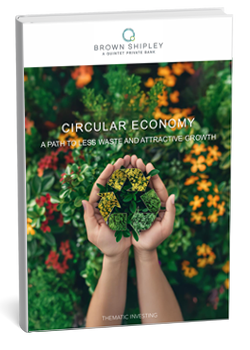
Let’s talk about investing in circular economy
These exclusive insights explore the sectors, innovations, and long‑term trends shaping the global circular‑economy landscape.
To receive advice and to become a client of Brown Shipley, you must have a minimum of £1M of investable assets.
The circular economy is a transition away from the traditional “take‑make‑waste” linear model toward a regenerative system designed to continually reuse resources. It focuses on durability, repairability, and recyclability, aiming to eliminate waste and reduce environmental impact while preserving valuable materials.
The circular economy addresses major global challenges such as environmental degradation, resource scarcity, supply chain instability, and rising regulatory pressures. Companies adopting circular practices can achieve greater resource efficiency, lower operational risks, and benefit from strong demand for sustainable solutions, making circularity a compelling long‑term theme for investors.
The global market for circular economy solutions is projected to grow from USD 690 billion* in 2024 to USD 2,882 billion* in 2031, representing annual growth of around 22%. This expansion is driven by regulatory support, supply chain reshoring, sustainability targets, and technological innovation, including AI‑enabled tools such as predictive maintenance that extend asset lifespan and reduce waste.
* Source: kingsresearch
Beneficiaries include companies involved in:
- Innovative design and materials, such as alternatives to plastics and sustainable construction inputs.
- Waste management and recycling, enabling material recovery and resource security.
- Industrial software and predictive maintenance, which extend the life of physical assets and reduce operational waste.
- Localised manufacturing and reshoring, as firms seek greater visibility and resilience in supply chains.
Challenges include:
- Dependence on shifts in regulation and sustainability targets.
- Geopolitical fragmentation, which can disrupt access to critical raw materials.
- The need for infrastructure scaling, such as recycling capacity and new material technologies.
- Differing levels of circularity adoption across industries, which may influence competitive positioning.
The circular economy is not just a theme; it’s a new way of extraction, production, conception, and consumption.
Alexandra Spasov – Funds Solution Analyst & Thematic Research
Download our Guide
Our guide offers clear insights, explaining what you need to consider and how circularity reshapes business models, resource use and long‑term investment opportunities.
Learn more about:
-
Economic Benefits: unlocking growth through innovation & resource efficiency
-
Environmental Impact: reducing waste and supporting sustainability goals
-
Resource Security: addressing geopolitical and supply chain pressures
-
Why the Circular Economy is in our thematic model portfolio
IMPORTANT INFORMATION
Information correct as of March 2026.
-
Investing involves risks and the value of investments may go up or down.
-
Business & Tax planning are not services regulated by the Prudential Regulation Authority or the Financial Conduct Authority.
-
This document is for information purposes only, does not constitute individual (investment or tax) advice and investment decisions must not be based merely on this document.
-
We recommend that you seek professional tax and legal advice to understand your personal tax liabilities. This will depend on personal circumstances and the prevailing tax rules, which are subject to change.
-
Brown Shipley and its employees cannot be held liable for any loss or damage arising out of the use of (any part of) this document.
This document is designed as marketing material. This document has been composed by Brown Shipley & Co Ltd (“Brown Shipley”). Brown Shipley
is authorised by the Prudential Regulation Authority and regulated by the Financial Conduct Authority and the Prudential Regulation Authority. Registered in England and Wales No. 398426. Registered Office: 2 Moorgate, London, EC2R 6AG.
This document is for information purposes only, does not constitute individual (investment or tax) advice and investment decisions must not be based merely on this document. Whenever this document mentions a product, service or advice, it should be considered only as an indication or summary and cannot be seen as complete or fully accurate. All (investment or tax) decisions based on this information are for your own expense and for your own risk. You should (have) assess(ed) whether the product or service is suitable for your situation. Brown Shipley and its employees cannot be held liable for any loss or damage arising out of the use of (any part of) this document.
The contents of this document are based on publicly available information and/or sources which we deem trustworthy. Although reasonable care has been employed to publish data and information as truthfully and correctly as possible, we cannot accept any liability for the contents of this document, as far as it is based on those sources.
Investing involves risks and the value of investments may go up or down. Past performance is no indication of future performance. Currency fluctuations may influence your returns.
The information included is subject to change and Brown Shipley has no obligation after the date of publication of the text to update or amend the
information accordingly. Accordingly, this material may have already been updated, modified, amended and/or supplemented by the time you receive or access it.
This is non-independent research and it has not been prepared in accordance with legal requirements designed to promote the independence of investment research, and that it is not subject to any prohibition on dealing ahead of the dissemination of investment research.
All copyrights and trademarks regarding this document are held by Brown Shipley, unless expressly stated otherwise. You are not allowed to copy, duplicate in any form or redistribute or use in any way the contents of this document, completely or partially, without the prior explicit and written
approval of Brown Shipley. Notwithstanding anything herein to the contrary, and except as required to enable compliance with applicable securities law. See the privacy notice on our website for how your personal data is used (https://brownshipley.com/en-gb/privacy-and-cookie-policy).