

The Great European Rebuild
5 mins to read this article






Europe is spending hundreds of billions of euros on defence, energy, and industry. While headlines often focus on individual policy announcements, the bigger story is the scale of investment taking place.
In recent years, Europe has faced a series of challenges. These exposed weaknesses in supply chains, energy security, and defence capabilities. In response, governments and policymakers have focused more on resilience, self-reliance, and long-term economic strength.
Defence budgets are rising. Energy systems are evolving. Power grids are being upgraded. Manufacturers are expanding capacity. At first glance, these may look like separate initiatives. They are not. Together, these developments are reshaping parts of the European economy and attracting growing attention from investors.
Four themes shaping Europe's rebuilding effort
1. Defence: Security becomes an economic priority
For much of the past three decades, it has received relatively little attention.
That has changed. Governments across Europe are spending more on defence. The EU's ReArm Europe plan could direct up to €800 billion towards defence and related industries.
Countries are replacing equipment, building new factories and investing in cyber security and air defence systems. Defence spending by EU member states rose from €218 billion in 2021 to an expected €381 billion in 2025.
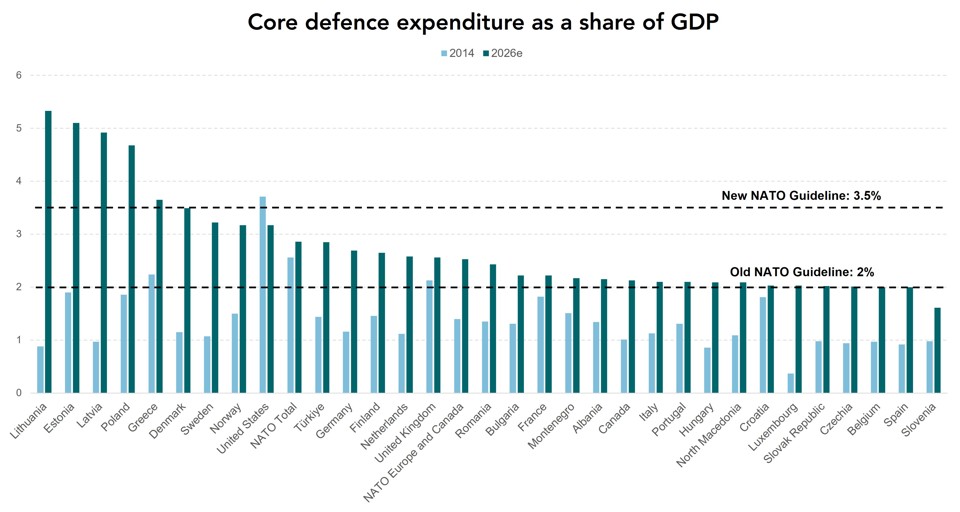
Data Source: NATO and IISS, 2025. EU Member States’ defence budgets | Epthinktank | European Parliament
The impact reaches beyond defence companies. Higher production requires engineers, electronics, software and specialist manufacturers. As governments invest in defence, the effects can spread across a wide range of industries.
2. Clean Energy: Turning vulnerability into strength
Europe's energy shock was painful. Natural gas prices surged, households faced higher bills, and companies saw costs rise sharply.
The response has been significant. Investment in renewable energy, energy storage and related projects has increased. The European Commission has committed €300 billion through its REPowerEU plan to improve energy security and reduce reliance on imported fossil fuels.
The aim is not only to reduce emissions. Producing more energy at home can improve resilience and reduce exposure to future disruptions. New solar, wind and battery projects can all contribute to that goal.
Demand for electricity is also growing. Investment in Artificial Intelligence (AI), the return of some manufacturing activity and greater use of electric vehicles, heating systems and industrial equipment are all increasing power demand.
3. Electrification: Rewiring the economy
Generating electricity is only part of the challenge. It must also be delivered where and when it is needed.
The EU has set out plans to increase the share of energy used as electricity from 23% today to 46% by 2040. That may create a challenge few people see.
In 2025, 47.3% of electricity generated in the EU came from renewable sources, with wind and solar accounting for the majority. June 2025 marked the first month in which solar became the EU’s largest source of electricity. However, two months earlier in Spain, some electricity networks were shut down due to mismanagement of grid network. This highlights the need for investment in transmission networks, distribution infrastructure and grid modernisation to handle changing patterns of supply and demand.
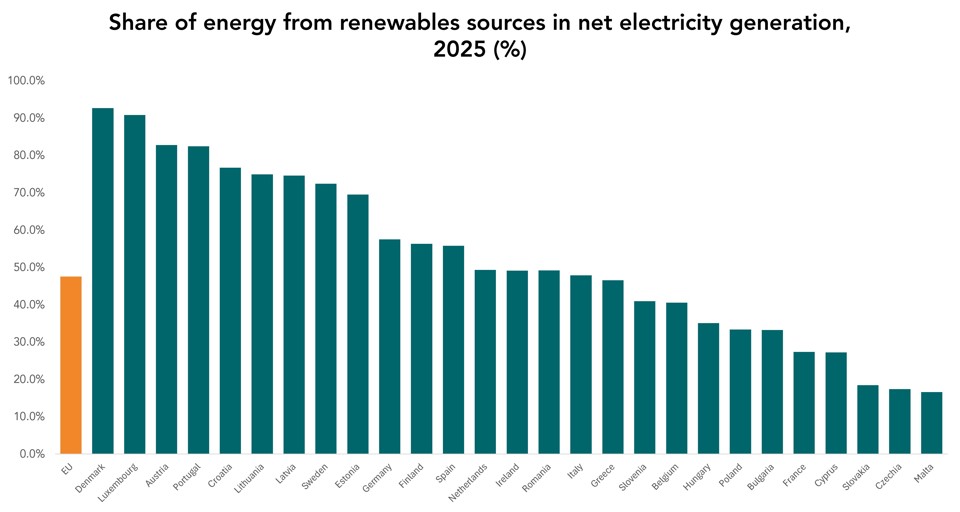
Source: 47% of EU’s electricity came from renewables in 2025 - News articles - Eurostat
In simple terms, Europe is rewiring itself. The companies building cables, transformers, switchgear, charging networks and grid infrastructure sit at the centre of this transformation.
4. Industrials: Turning plans into reality
Many of Europe's industrial companies will play a significant role in these developments.
They build factories, tools, engineering equipment, and power-management technologies. While these businesses often attract less attention than large tech firms, they play a critical role in turning policy ambitions into physical assets.
From electricity networks to defence, many of Europe's goals depend on industrial companies. The scale of investment required is substantial. The European Commission estimates that around €584 billion will be needed by 2030 to modernise and expand Europe's electricity networks. Spending on defence, energy and manufacturing is also increasing demand for specialist equipment and expertise.
As Europe looks to improve its defence and energy capabilities, industrial companies look set to become the builders of the continent’s next chapter.
Why investors are paying attention
Major economic shifts often unfold over many years rather than through a single policy decision.
What makes Europe's rebuilding effort distinctive is its scale and breadth. Defence, clean energy, electricity networks and industrials may appear to be separate themes. In practice, they are all linked to a broader effort to strengthen resilience, competitiveness and economic security.
However, announcements alone do not transform economies. The ultimate outcome will depend on what gets built. Investment must lead to new projects, infrastructure and productive capacity.
Even so, the scale of spending already committed suggests that these themes could remain important features of the European economic landscape for years to come.
For investors, the question is no longer whether Europe is rebuilding. It is who will be supplying the bricks.
Important Information
Information correct as of 8 October 2026.
This document is designed as marketing material. This document has been composed by Brown Shipley & Co Ltd ("Brown Shipley”). Brown Shipley is authorised by the Prudential Regulation Authority and regulated by the Financial Conduct Authority and the Prudential Regulation Authority. Registered in England and Wales No. 398426. Registered Office: 2 Moorgate, London, EC2R 6AG.
This document is for information purposes only, does not constitute individual (investment or tax) advice and investment decisions must not be based merely on this document. Whenever this document mentions a product, service or advice, it should be considered only as an indication or summary and cannot be seen as complete or fully accurate. All (investment or tax) decisions based on this information are at your own expense and at your own risk. You should (have) assess(ed) whether the product or service is suitable for your situation. Brown Shipley and its employees cannot be held liable for any loss or damage arising out of the use of (any part of) this document.
The contents of this document are based on publicly available information and/or sources which we deem trustworthy. Although reasonable care has been employed to publish data and information as truthfully and correctly as possible, we cannot accept any liability for the contents of this document, as far as it is based on those sources.
Investing involves risks and the value of investments may go up or down. Past performance is no indication of future performance. Currency fluctuations may influence your returns.
The information included is subject to change and Brown Shipley has no obligation after the date of publication of the text to update or amend the information accordingly. Accordingly, this material may have already been updated, modified, amended and/or supplemented by the time you receive or access it.
This is non-independent research, and it has not been prepared in accordance with legal requirements designed to promote the independence of investment research and is not subject to any prohibition on dealing ahead of the dissemination of investment research.
All copyrights and trademarks regarding this document are held by Brown Shipley, unless expressly stated otherwise. You are not allowed to copy, duplicate in any form or redistribute or use in any way the contents of this document, completely or partially, without the prior explicit and written approval of Brown Shipley. Notwithstanding anything herein to the contrary, and except as required to enable compliance with applicable securities law. See the privacy notice on our website for how your personal data is used (https://brownshipley.com/en-gb/privacy-and-cookie-policy).
© Brown Shipley 2026