



What matters to you in 30 seconds:
- Bonds are becoming more interesting. Higher yields mean investors can once again earn meaningful income from high-quality bonds.
- We remain positive on growth, but more selective on risk. Equity markets have stayed resilient despite higher interest rates, but we have added downside protection in eligible portfolios.
- Friday’s US jobs report could be the week’s key market event. Strong nonfarm payrolls data would reinforce expectations for another interest rate hike, while weaker figures could ease pressure on the US Federal Reserve (Fed).
Chart of the week
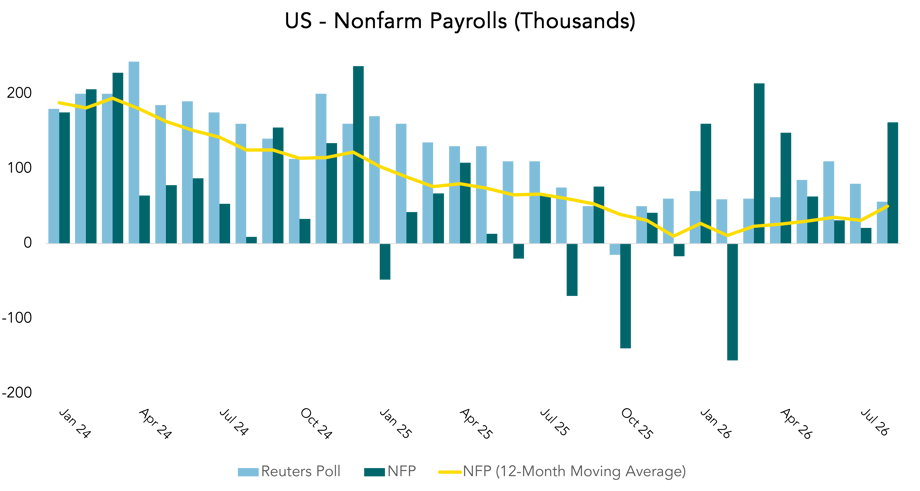
Source: In-house research, LSEG Datastream




Bonds
Income is back
For years, investors had to accept very little income from high-quality bonds. That environment is changing.
Government bond yields rose again last week across developed markets. Stronger-than-expected economic data and inflation fears prompted investors to reassess the likelihood of further interest rate increases. Fiscal concerns have also contributed to upward pressure on yields. Another, less obvious factor may be the huge investment being directed towards AI infrastructure, which is increasing competition for capital.
Yet focusing on last week’s market move risks missing the bigger story. Bond yields have largely returned to levels that are much closer to long-term historical averages. In many ways, today’s environment looks more normal than the unusually low-rate period that followed the Global Financial Crisis and the Covid shock.
For investors, this matters. Higher yields increase the income available from holding bonds and provide a larger buffer against future market moves. That cushion is now meaningful. Based on our analysis, the yield on the 10-year US Treasury would need to rise to roughly 5.7% over the next year, or around 6.6% over the next two years, before total returns turned negative.
Short-term volatility is still possible. Policy uncertainty, energy prices and competition from strong equity returns could continue to pressure bond markets. Even so, bonds are increasingly able to perform the role investors traditionally expected of them: generating income while contributing to portfolio diversification.
Portfolios
Optimistic, but not complacent
Financial markets continue to adapt to a world of higher interest rates. At the same time, geopolitical tensions and uncertainty in energy markets have increased concerns that inflation may prove more persistent than many expected.
Historically, periods of sharply rising bond yields have often unsettled financial markets. So far, 2026 has been different. Despite higher borrowing costs, equity markets have remained resilient.
One reason may be the powerful investment cycle taking place in AI. Combined with increased spending on energy infrastructure and defence, it has helped support economic activity and investor confidence.
Against that backdrop, we remain moderately overweight equities, yet selective. We continue to favour UK equities for its defensive properties and emerging market equities, where growth prospects remain relatively attractive.
That said, strong market performance this year means there is less room for disappointment. For that reason, we have recently increased downside protection within portfolios where regulation and client circumstances permit. Our objective is not to reduce our participation in growth, but to improve resilience should markets become more volatile.
We also remain overweight gold. Growing concerns about debt sustainability across major economies have reinforced its appeal for some investors. Gold may also provide diversification benefits during periods of economic weakness, although its price can be volatile.
Our overall message has not changed. We believe economic growth remains positive, but we see value in balancing participation in that growth with protection against unexpected shocks.
Geopolitics
US-China: less tensions, not a resolution
The relationship between the US and China appeared somewhat more stable last week.
The meeting between Presidents Xi Jinping and Donald Trump generated considerable attention but produced few major policy announcements. More important for markets was the decision to extend last year’s trade truce by two months, keeping tariffs at lower levels until 10 January.
The extension was shorter than many officials had previously suggested. Even so, it gives both sides additional time to pursue a broader agreement and reduces some immediate risks for global markets.
Investors should be careful not to confuse stabilisation with resolution. Strategic competition in areas such as technology, trade and national security remains firmly in place.
Attention will now shift back towards domestic developments.
In China, investors will watch for further signals from policymakers on measures designed to support consumption, housing and economic growth. The challenge remains clear: production continues to outpace consumption, increasing pressure on policymakers to stimulate domestic demand.
In the US, focus is gradually turning towards the approaching midterm elections. Our base case remains a divided Congress, with Democrats regaining control of at least one chamber. While the election result itself matters, investors will be more interested in what it implies for future policy and spending plans.
US midterms could shape the policy backdrop
The economic impact of higher energy costs is becoming increasingly visible. In the US, rising fuel prices are weighing on consumer confidence and adding to political uncertainty ahead of the November midterm elections. Our base case remains a divided Congress, with the Democrats winning the House and the Republicans retaining control of the Senate. If this happens, it could reduce the likelihood of significant policy changes during the remainder of President Trump’s term, including additional fiscal support and deregulation.
From a market perspective, we do not expect a divided Congress to have a material effect on the earnings trend, meaning broad US equities should remain well positioned. A divided Congress could also reinforce the case for high-quality fixed income. If legislative gridlock reduces the likelihood of significant fiscal expansion, inflation and interest-rate expectations may become even more important for markets. At the same time, higher yields mean bonds now offer a more meaningful source of income than much of the past decade. In a market environment where uncertainty remains elevated, that combination remains attractive.
This week
Can the economy stay strong without reigniting inflation?
The key question for investors this week is whether economic growth remains strong enough to support corporate earnings without creating renewed inflation pressures.
In Europe, inflation data from Spain, France, Italy and Germany will culminate in the Eurozone reading on Friday. With oil prices remaining around USD 100 per barrel, headline inflation is expected to stay elevated.
Markets currently expect the European Central Bank to raise interest rates again. While there is a risk that the central bank does increase rates slightly more, we don’t expect a series of hikes. Higher energy prices reduce consumers’ spending power and may eventually weaken demand, which could allow policymakers to remain on hold.
In the US, attention will focus on the Fed’s preferred measure of inflation, the core personal consumption expenditures index, alongside a series of labour-market indicators including job openings, private payrolls and Friday’s non-farm payrolls report.
Last month’s employment data was strong. If this week’s figures tell a similar story, investors may become more confident that the Fed has one further rate increase ahead. That remains our base case, potentially at either the October or December meeting.
China will also remain in focus. Business surveys released during the week will provide another indication of the balance between production and domestic demand. Investors will look for signs that policymakers may be prepared to accelerate support measures ahead of the Central Committee plenum in late October.
Important Information
Information correct as of 28 September 2026.
This document is designed as marketing material. This document has been composed by Brown Shipley & Co Ltd ("Brown Shipley”). Brown Shipley is authorised by the Prudential Regulation Authority and regulated by the Financial Conduct Authority and the Prudential Regulation Authority. Registered in England and Wales No. 398426. Registered Office: 2 Moorgate, London, EC2R 6AG.
This document is for information purposes only, does not constitute individual (investment or tax) advice and investment decisions must not be based merely on this document. Whenever this document mentions a product, service or advice, it should be considered only as an indication or summary and cannot be seen as complete or fully accurate. All (investment or tax) decisions based on this information are at your own expense and at your own risk. You should (have) assess(ed) whether the product or service is suitable for your situation. Brown Shipley and its employees cannot be held liable for any loss or damage arising out of the use of (any part of) this document.
The contents of this document are based on publicly available information and/or sources which we deem trustworthy. Although reasonable care has been employed to publish data and information as truthfully and correctly as possible, we cannot accept any liability for the contents of this document, as far as it is based on those sources.
Investing involves risks and the value of investments may go up or down. Past performance is no indication of future performance. Currency fluctuations may influence your returns.
The information included is subject to change and Brown Shipley has no obligation after the date of publication of the text to update or amend the information accordingly. Accordingly, this material may have already been updated, modified, amended and/or supplemented by the time you receive or access it.
This is non-independent research, and it has not been prepared in accordance with legal requirements designed to promote the independence of investment research and is not subject to any prohibition on dealing ahead of the dissemination of investment research.
All copyrights and trademarks regarding this document are held by Brown Shipley, unless expressly stated otherwise. You are not allowed to copy, duplicate in any form or redistribute or use in any way the contents of this document, completely or partially, without the prior explicit and written approval of Brown Shipley. Notwithstanding anything herein to the contrary, and except as required to enable compliance with applicable securities law. See the privacy notice on our website for how your personal data is used (https://brownshipley.com/en-gb/privacy-and-cookie-policy).
© Brown Shipley 2026